
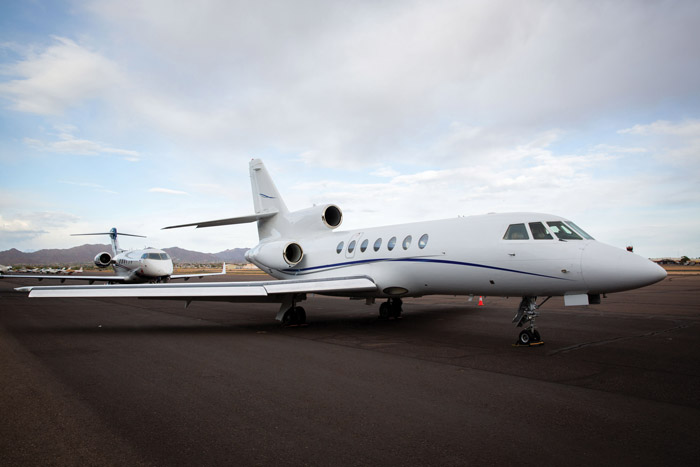
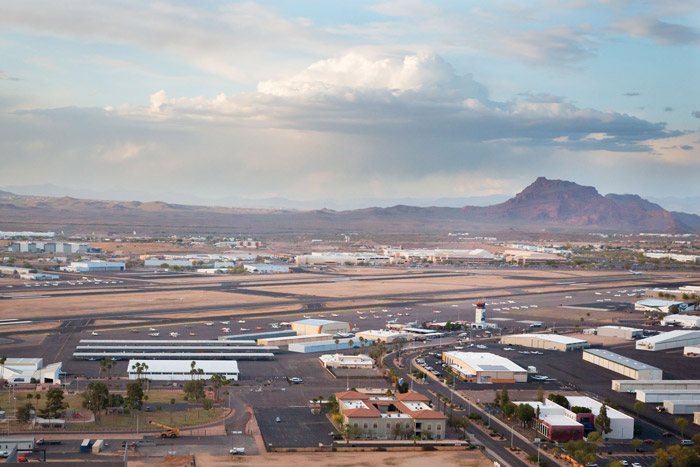
Organizers at Falcon Field in Mesa have increased their resources to address the growing jet traffic noise at the airfield, much of which has been created by the city’s push to boost commercial aviation, infrastructure, and new developments. The demand continues to grow.
“We’re seeing unprecedented business aviation developments at Falcon Field Airport. This reflects a strong demand and confidence in our airport,” said Airport Administration Manager, Dee Anne Thomas. “We’re also preparing for the future of aviation — investing in infrastructure and innovation to ensure Falcon Field remains a premier destination for business and recreation.”
The City of Mesa increased its efforts to attract commercial air traffic at Falcon Field in 2022 with a $150 million, 775,000-foot expansion project at the north end of the airfield, adding high end hangars and the infrastructure to support them. There is also a startup rocket building facility on the premises.
“Falcon Field Airport is proud to play a key role in he growth of business aviation on a national level. Our strategic location is one of many reasons companies are choosing to invest here, developing premier hangar space to meet the increasing demand from corporate operators across the country,” Airport Director, Corinne Nystrom, said. “These developments mark a significant advancement in the services offered at the airport, and they contribute to the ongoing economic strength of both the airport and the surrounding community.”
While the Federal Aviation Administration manages the airspace, Falcon Field’s efforts to reduce noise from air traffic stretch back to 2007 when the City of Mesa started encouraging pilots to voluntarily follow noise abatement guidelines established by the Aircraft Owners and Pilots Association and the National Business Aircraft Association.
The city also formed a committee with members of the FAA, other pilot organizations, airport tenants, and local residents to discuss air traffic noise concerns.
In 2009, Mesa established a Falcon Field Ad-Hoc Task Force, including community members and airport businesses, to recommend solutions to balancing aircraft noise concerns and airport operations, and presented their findings to the City, which were implemented.
“Seek reasonable ways to mitigate community safety and noise concerns,” the plan says.
The plan also encourages pilots, including those who are receiving flight training, to always fly tight patterns that stay as close to the airport as possible and to approach the runways when landing at or above the downward sloping path provided by the precision approach path indicator landing aid system.
Pilots are also expected to adjust their engine speeds smoothly and slowly as they approach the airfield to reduce the possibility of creating a sudden “noise event.”
Planes taking off from Falcon Field are expected to climb as quickly as possible until reaching an altitude of 2,400 feet, and to maintain a minimum altitude of at least 1,000 feet above the ground when flying over populated areas, except when landing or taking off. This is in line with FAA regulations, the plan says.
In the years since the 2009 recommendations were crafted, the Federal Aviation Administration has established an online portal to receive noise complaints, and the City of Mesa has established a local version.
The City of Mesa has also installed aircraft tracking software at Falcon Field, helping to analyze flight paths and altitudes, track 3D flight data, “ghosted” aircraft, military ops, and touch-and-go full landings.
Officials have also developed a noise abatement training video, which is required watching for any pilot applying for airfield credentials. The training is also provided to all flight schools at Falcon Field and throughout Arizona. The video is posted at falconfieldairport.com.
Beyond the software upgrades, handouts on noise abatement for pilots, and the training video, airport staff has pledged to be, “good neighbors to the surrounding community.”
The airport has also increased its efforts to be sure the airfield is safe and has required city airfield workers to complete an annual training program.
For more information, visit falconfieldairport.com.